


Website SEO Audits That Deliver Measurable Results for Small Businesses
An effective SEO audit is a methodical review of the parts of your site that determine search visibility and lead generation: technical setup, page content, backlinks, local signals, and performance data. Below we explain how technical checks, content analysis, backlink reviews, local SEO scans, and performance diagnostics turn into a prioritized action plan that moves the needle for small businesses. We know budgets and time are limited, so the focus is on high‑impact, measurable fixes that maximize marketing ROI. Keep reading for our audit workflow, hands‑on checklists, prioritization tables, and plain‑English tips for interpreting metrics like LCP, CLS and organic CTR — plus guidance on choosing a provider who actually drives leads.
What is a Comprehensive Website SEO Audit and Why is it Essential?
A comprehensive SEO audit inspects indexability, on‑page relevance, content quality, backlink health, local signals and performance metrics to surface the barriers that keep a site from ranking and converting. The audit connects each issue to how search engines evaluate pages — for example, indexability problems limit the pages bots can find; thin or off‑topic content hurts relevance; and slow pages worsen Core Web Vitals, reducing engagement and potentially lowering rankings. For small businesses, addressing these problems usually delivers clear benefits: better search visibility, more qualified organic traffic, and more leads when fixes are prioritized and tracked against KPIs. Below we outline typical deliverables, a remediation roadmap, and how audit findings map to business outcomes so you can set realistic expectations and prioritize the fastest wins.
Research consistently shows that a focused SEO approach produces measurable improvements in visibility and broader marketing outcomes.
SEO Strategy for Visibility & Marketing Goals
Studies show that a well‑executed SEO strategy increases a website’s visibility and organic traffic, which supports brand awareness and creates more opportunities for conversions. When teams follow ethical, search‑engine‑compliant practices, SEO becomes a durable channel for building trust and steady marketing growth.
How an audit drives results depends on what we find and the action plan that follows. The next section gives concrete cause‑and‑effect examples showing how common fixes translate into performance gains.
How does an SEO audit improve website performance?
An audit finds the root causes that stop search engines from finding your pages or that frustrate visitors — then recommends targeted fixes to restore or strengthen ranking signals. For example, large images and slow servers hurt Largest Contentful Paint (LCP), which can increase bounce rates and reduce conversions until optimized. Fixing crawlability issues — like robots.txt or sitemap errors — lets search engines index valuable pages and increases impressions and clicks. Audits also surface content gaps and keyword mismatches so on‑page updates raise relevance and lift CTR. In short: speed → better engagement → improved rankings; indexability → visibility; content relevance → more clicks. That’s how technical findings translate into measurable SEO performance.
Further studies emphasize the role of web‑performance tooling and Core Web Vitals in shaping user experience and conversion outcomes.
Web Performance Tools & Core Web Vitals for SEO
Research into tools like Lighthouse, PageSpeed Insights and WebPageTest shows how Core Web Vitals reflect real user experience. Metrics such as LCP and FID/INP link directly to engagement — and improving them can lower bounce rates and boost conversions when combined with solid on‑page and technical fixes.
Next, we list the audit components so you can see exactly what a full audit covers and the outcomes to expect.
What components are included in a full SEO audit?
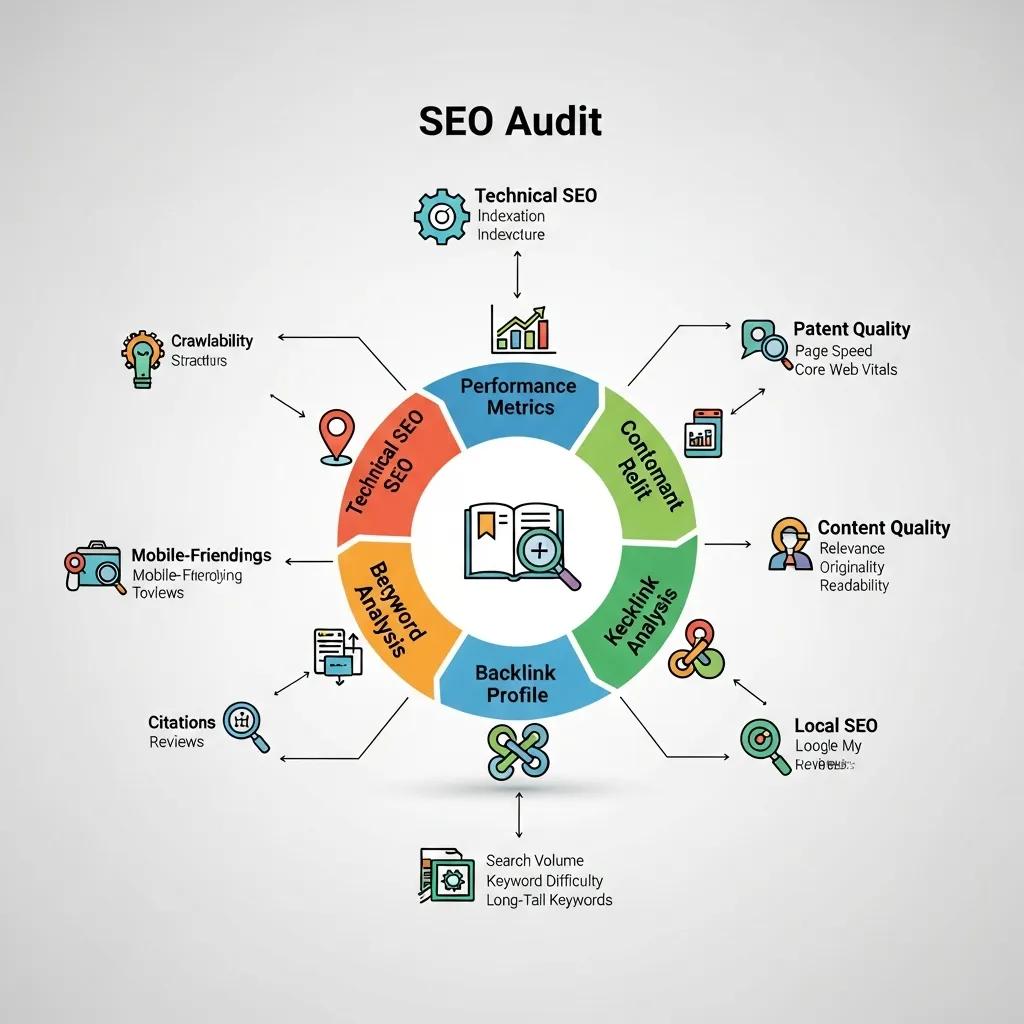
A full audit inspects technical infrastructure, page‑level SEO, content quality and gaps, backlink profile health, local signals for service‑area businesses, and analytics/tracking to measure conversions. The table below summarizes each component, what we check, and the metric or outcome you should expect so teams can quickly decide where to focus remediation.
| Component | What it checks | Expected outcome / Metric |
|---|---|---|
| Technical SEO | Robots.txt, sitemap.xml, canonical tags, redirects, indexability | Improved crawlability; more indexed pages |
| Performance & Core Web Vitals | LCP, CLS, INP/FID, TTFB, image and resource optimization | Faster loads; lower bounce; stronger engagement |
| On-Page Content | Titles, meta descriptions, headings, schema, keyword relevance | Higher topical relevance; improved CTR |
| Backlink Audit | Link quality, toxic domains, anchor diversity | Cleaner link profile; reduced risk of penalties |
| Local SEO | Google Business Profile signals, NAP consistency, citations, local schema | Better map‑pack visibility; more local conversions |
| Analytics & Tracking | GA4/GSC setup, conversion tracking, event tagging | Accurate measurement and ROI tracking |
This component summary helps teams turn audit findings into measurable remediation tasks and the specific metrics to track after fixes are applied.
For many small businesses the fastest path is a professional engagement — MarketMagnetix Media Group delivers audits that convert findings into prioritized remediation plans tied to lead‑generation goals.
How to Conduct a Technical SEO Audit: Checklist and Best Practices
A technical audit confirms that search engines can crawl, render and index your pages and that server, security and structured data are configured to support rankings. Typical steps begin with a full crawl, validate robots and sitemaps, measure Core Web Vitals with lab and field tools, review redirects and canonicalization, and finish with structured data and mobile usability checks.
Executing these steps produces a prioritized list of issues sorted by impact and effort so developers and marketers can triage work efficiently. Below is a step‑by‑step checklist and a priority table to guide what to fix first.
- Run a full site crawl and export errors, redirects and canonical issues.
- Check robots.txt, sitemap.xml and index coverage in Google Search Console.
- Measure Core Web Vitals and TTFB using PageSpeed Insights and real‑user data.
- Audit HTTPS configuration, redirect chains and server response codes.
- Validate structured data, hreflang (if used) and mobile usability.
This checklist gives engineers and SEO specialists a clear data‑collection sequence and a practical starting point for remediation.
The table below helps prioritize issues by SEO impact and implementation effort.
| Issue | Impact (SEO & UX) | Fix Complexity / Estimated Effort |
|---|---|---|
| Broken or chained redirects | High: link equity loss and crawl waste | Medium: routing and server config fixes |
| Slow LCP from unoptimized images | High: lower engagement and rankings | Low–Medium: compress and serve responsive images |
| Incorrect robots or missing sitemap | High: pages not indexed | Low: update files and resubmit sitemap |
| Missing or invalid schema | Medium: fewer rich results | Low: add or correct markup |
| Mixed content or SSL issues | High: security warnings and ranking impact | Medium: certificate and asset updates |
Use this remediation table to focus developer time on high‑leverage tasks that yield measurable SEO gains first.
After these technical checks, many teams prefer an external audit partner to turn findings into a delivery plan and implementation support. MarketMagnetix Media Group offers engagement options to run audits, deliver prioritized roadmaps, and coordinate fixes with development teams.
Which technical elements impact website ranking the most?
The technical items with the most immediate effect are mobile usability, Core Web Vitals (LCP, INP/FID, CLS), indexability controls, secure HTTPS configuration, and structured data where relevant. Mobile‑first indexing means responsive layouts and touch targets factor into Google’s evaluation; Core Web Vitals reflect real user experience that correlates with engagement; indexability errors can silently block pages from discovery; and TLS/HTTPS plus clean redirect chains preserve trust and link equity. Addressing these areas typically produces visible improvements in impressions and click‑through rates.
Knowing which elements move the needle helps prioritize your audit checklist — the next section describes an effective triage workflow.
How to use a technical SEO audit checklist effectively?
Collect data first, tag issues by impact and effort, then convert findings into assignable tickets for implementation and verification. Start with automated collection — run a site crawler, pull Search Console coverage, and gather field Core Web Vitals. Score each finding with an impact vs effort matrix, group quick wins (high impact / low effort) for immediate fixes, and schedule engineering work for larger items. Finally, create developer tickets with reproduction steps, expected outcomes and verification tests so fixes can be validated after deployment. This workflow keeps audits from stalling and ensures work ties back to measurable outcomes.
A clear triage process reduces rework and lets small‑business teams focus on the fixes that move KPIs fastest.
What Local SEO Audit Services Can Boost Small Business Visibility?

Local SEO audits target the signals that drive map‑pack visibility and nearby organic results — Google Business Profile completeness, citation consistency, review health, locally relevant content and local schema. These audits ensure local listings and pages are discoverable and credible in geographic searches, which typically increases calls, direction requests and nearby conversions. For service‑area businesses like contractors, clinics or shops, prioritizing local signals often delivers faster conversion wins than broader SEO work alone. Below are local audit steps and tactical fixes to improve map‑pack presence and local organic rankings.
Local audits emphasize accuracy and consistency across listings and the website, which requires a slightly different checklist than a standard SEO audit.
How does local SEO differ from general SEO audits?
Local SEO focuses on proximity and trust signals — Google Business Profile details, NAP (Name, Address, Phone) consistency, citation accuracy and review velocity — rather than only broad topical authority. General audits look at site‑wide indexability, content relevance and backlinks; local audits prioritize the attributes that influence local search and map‑pack rank. Citation consistency and correct business categories affect local relevance, while review volume and how you respond influence trust and conversions. Local audits also check local schema and service‑area landing pages to make sure your site signals location intent clearly to search engines. Because of these differences, local audits use additional data sources and a different remediation order to capture geographically driven demand.
This distinction explains why small businesses with local customers need targeted local checks; the next section lists the specific local factors to audit.
Which local SEO factors should be audited for small businesses?
A thorough local audit verifies Google Business Profile completeness and categories, NAP consistency across key citations, review volume and response practices, localBusiness schema, and location‑specific landing page optimization.
- Confirm Google Business Profile entries: categories, business description, photos and services are accurate.
- Audit NAP consistency across primary citation sources and industry directories.
- Evaluate reputation: review volume, recency and your response strategy.
- Implement or validate localBusiness schema and optimize service‑area pages for local intent.
Completing this checklist builds a consistent, trustworthy local footprint that search engines and customers can rely on.
These local fixes typically raise map‑pack visibility and translate directly into more qualified local leads.
How to Analyze Website Performance for SEO Improvement?
Analyzing performance for SEO means mapping search and technical metrics to user behavior and conversion outcomes, then prioritizing fixes that deliver measurable gains. Combine organic KPIs — impressions, clicks, CTR and conversions — with technical metrics like LCP, INP/FID, CLS and TTFB, and link them to page issues such as heavy resources, slow servers or thin content. Use Google Search Console, site analytics and field performance tools to spot pages with high impressions but low CTR, or high traffic but poor conversions, then prescribe targeted remediation based on those findings.
Below is a metrics table pairing key signals with benchmarks and common corrective actions.
| Metric | Diagnostic benchmark / target | Typical action |
|---|---|---|
| LCP (Largest Contentful Paint) | Target: ≤2.5s | Optimize and serve compressed images, preload hero resources, use critical CSS |
| INP / FID (Interaction latency) | Target: low ms | Reduce main‑thread work, defer or async non‑critical JS |
| CLS (Cumulative Layout Shift) | Target: <0.1 | Reserve image/ad dimensions, avoid late layout shifts |
| TTFB (Time to First Byte) | Target: <200–500ms | Server tuning, CDN, caching |
| Organic CTR | Benchmark: varies by SERP | Improve titles and snippets, add schema for rich results |
This mapping turns observed shortfalls into concrete technical or content fixes and measurable targets to track after remediation.
With the right metrics in hand, follow a troubleshooting workflow to isolate root causes and fix the performance issues holding SEO back.
What metrics indicate website SEO performance?
Key SEO performance metrics include organic impressions and clicks, CTR by page and query, conversion rates and funnel leakage, plus field technical metrics like LCP, INP/FID, CLS and TTFB. Impressions measure discovery, clicks show attraction, CTR reveals snippet relevance, and conversion metrics highlight landing page and funnel quality. Real‑user performance data shows actual user experience that influences engagement and rankings. Correlating trends across Search Console, analytics and performance tools gives you the evidence to prioritize fixes effectively.
Interpreting these metrics leads to a methodical approach for diagnosing root causes and implementing practical improvements.
How to identify and fix performance issues affecting SEO?
Start with root‑cause analysis that combines page‑level Core Web Vitals, server timing and resource waterfalls to see whether issues stem from front‑end assets, server latency or third‑party scripts. Common quick wins include compressing and resizing images, enabling efficient caching, using responsive images and lazy loading, and deferring non‑critical JavaScript. Larger fixes may require code‑splitting, extracting critical CSS, server‑side rendering tweaks, or infrastructure upgrades like adding a CDN or increasing server resources. Measure uplift by comparing pre‑ and post‑fix LCP, CLS and INP in field data and by tracking changes in engagement and conversion KPIs. That validation keeps work tied to measurable SEO improvement.
Following these diagnostics and remediation steps prepares teams to quantify uplift; the next section explains why a professional audit partner can accelerate results.
Why Choose Professional SEO Audit Services for Small Businesses?
Professional audits bring specialized tools, experience prioritizing high‑impact fixes, and the ability to turn technical findings into an actionable roadmap that drives lead generation. Experts can quickly combine cross‑tool data — crawls, Search Console, field performance metrics — and produce a prioritized plan aligned to business KPIs like qualified traffic and conversions. For small businesses with limited bandwidth, outsourcing shortens time‑to‑value by delivering clear developer tickets and strategic marketing recommendations. When evaluating providers, favor transparent reporting, measurable case results and a clear handoff process for implementation; the sections below outline benefits and vendor criteria to help you choose wisely.
MarketMagnetix Media Group specializes in small‑business audit engagements that convert technical findings into prioritized remediation roadmaps focused on driving measurable lead‑generation outcomes.
What benefits do expert SEO audits provide?
Expert audits speed up identification of high‑impact issues, prioritize work to maximize ROI, and provide access to enterprise tools and reporting without the licensing burden. Practitioners use experience‑based triage to surface quick wins that improve traffic and conversions while scheduling deeper engineering work for long‑term gains. They also produce clear, business‑focused reports that make it easier for stakeholders to approve implementation and measure results. Many engagements include verification and monitoring so you can track uplift against baseline KPIs and quantify the value of each fix.
These benefits make professional audits especially valuable for small businesses that need measurable outcomes without expanding internal resources.
How to select the right SEO audit service for your business?
When choosing a provider, look for experience with small‑business use cases, ask for sample reports and remediation roadmaps, confirm their prioritization method (impact vs effort), and make sure verification and monitoring are included. Use the checklist below to vet providers and ensure they translate technical findings into business‑focused recommendations.
- Request sample audit reports and clear remediation roadmaps.
- Ask how they prioritize fixes and whether verification is included after fixes.
- Confirm recommendations align with business KPIs and include measurable targets.
Choose a vendor with a track record of turning audits into measurable lead‑generation gains so your investment targets work that actually moves the needle.
This vendor guidance sets expectations for outcome‑driven audits; MarketMagnetix Media Group positions its services to deliver prioritized implementation plans that emphasize lead generation and measurable organic uplift.
Frequently Asked Questions
What is the typical duration of a comprehensive SEO audit?
Audit timelines depend on site size and complexity. A small site can be audited in a few days; larger sites with extensive content or technical complexity may take several weeks. Scope, access to data, and the number of components analyzed also affect timing. Allow enough time for a thorough assessment so recommendations are practical and actionable.
How often should small businesses conduct SEO audits?
We recommend a full audit at least once or twice a year, and after any major site change such as a redesign or CMS migration. More frequent checks make sense for seasonal businesses or when performance is volatile. Regular audits help spot issues early, measure progress and adapt to search algorithm changes.
Can I perform an SEO audit myself, or should I hire a professional?
Basic audits are possible with off‑the‑shelf tools, but professionals add value for comprehensive analysis. Agencies bring experience, advanced tooling and the ability to spot nuanced issues and prioritize fixes. If you lack SEO expertise or internal bandwidth, hiring an expert often saves time and produces better results.
What tools are commonly used in SEO audits?
Common tools include Google Search Console for coverage and performance, SEMrush or Ahrefs for backlink analysis, Screaming Frog for crawling, and PageSpeed Insights, WebPageTest or GTmetrix for performance and Core Web Vitals. Combined with analytics and server logs, these tools give a full view of site health.
What are the costs associated with professional SEO audit services?
Costs vary by provider, scope and site size. Basic audits can start in the low hundreds, while comprehensive audits for larger sites typically range from $1,000 to several thousand dollars. Evaluate the depth of analysis, clarity of reporting, and expected uplift — a quality audit should pay for itself through improved traffic and conversions.
What should I expect in the report after an SEO audit?
A strong audit report clearly outlines findings, explains their impact on performance, and provides prioritized, actionable recommendations. Expect sections for technical SEO, on‑page content, backlinks, local SEO (if applicable) and analytics, with remediation steps, estimated effort and metrics to track. A well‑structured report helps you turn findings into a practical implementation plan and measurable outcomes.