
Smart, Scalable Ad Solutions Built for SMB Growth
Programmatic advertising automates the buying and placement of digital ads in milliseconds, replacing manual insertion orders and long negotiation cycles. For small and medium-sized businesses, that automation delivers scalable precision: the right creative meets the right audience at the right moment while teams and budgets stay lean. This article breaks down how automated ad buying works, why real-time bidding and demand-side platforms matter when budgets are tight, and which formats and measurement methods tend to produce the best returns. You’ll also get practical next steps—goal setting, budget pacing, creative tips, and first-party data integration—so you can run campaigns in-house or hand a clear brief to an agency. Below we cover core mechanics, concrete benefits, an implementation checklist with KPIs, channel recommendations, 2024 trends like AI-driven optimization and privacy-first measurement, and how MarketMagnetix Media Group weaves programmatic into an omnichannel growth plan.
What is Programmatic Advertising and How Does Automated Ad Buying Work for Small Businesses?
Programmatic advertising uses software to buy digital ad space automatically instead of relying on manual orders and back-and-forth deals. It runs on micro-auctions and real-time decisioning: when a page loads or an ad slot opens, an auction evaluates bids and audience signals and selects the creative to serve. For SMBs, automation cuts operational overhead and enables precise targeting by combining audience data, contextual cues, and performance rules so you only bid on impressions that align with your goals. The outcome is more efficient spend and faster optimization than traditional buying. Knowing the flow—impression → auction → bid decision → creative delivery—lets SMBs vet vendors and set realistic performance expectations.
How Does Real-Time Bidding Enable Efficient Ad Purchases?

Real-Time Bidding (RTB) is the split-second auction that runs whenever an ad opportunity appears, matching advertisers’ bids to an impression’s audience and context. RTB combines signals—user attributes, device, location, and past behavior—so automated rules favor impressions that meet campaign KPIs. For budget-conscious SMBs, RTB reduces waste by avoiding broad, untargeted buys and by using frequency controls and pacing to prevent overexposure. For example, a local contractor can target people searching “roof repair” in specific ZIP codes rather than buying broad display packages. That auction-driven approach speeds optimization and improves cost efficiency for smaller campaigns.
What Roles Do Demand-Side Platforms and Ad Exchanges Play in Programmatic Media Buying?
A Demand-Side Platform (DSP) is the advertiser’s control center for programmatic campaigns: it aggregates inventory, applies audience targeting and bidding logic, and surfaces reporting. Ad exchanges are the marketplaces that connect DSPs to supply-side platforms (SSPs) representing publishers—these exchanges are where auctions happen. For SMBs, DSPs offer broad inventory access and tools like lookalike modeling, creative rotation, and consolidated reporting to track ROAS. When choosing a DSP, look for clear reporting, ease of use, first-party data integration, and fee structures that suit smaller budgets. A DSP with solid onboarding and transparent metrics makes programmatic accessible without a large media team.
What Are the Key Benefits of Programmatic Advertising for Small and Medium-Sized Businesses?
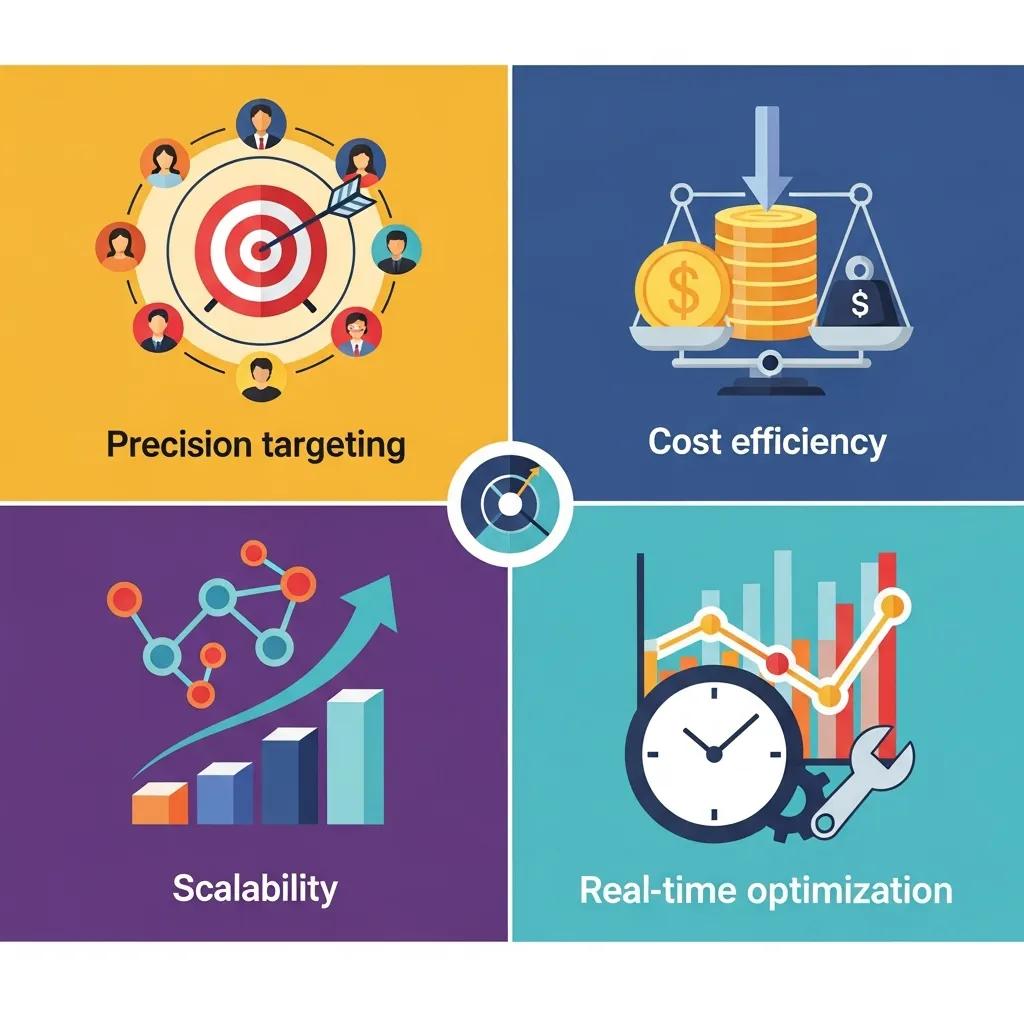
Programmatic advertising gives SMBs measurable gains in targeting, cost control, scale, and speed of optimization—turning ad spend into a more predictable performance channel. The automation layer supports continuous bid and creative testing, while unified reporting reveals which audiences and placements drive leads or sales. Below are the primary benefits to highlight programmatic’s ROI potential.
Programmatic advertising delivers four core advantages for SMBs:
- Precision Targeting: Deeper audience segmentation reduces wasted impressions and improves conversion rates.
- Cost Efficiency: Automated bidding and pacing lower CPMs and lift ROAS through smarter auctions.
- Cross-Channel Reach and Scalability: Programmatic unifies display, video, audio, and CTV so you meet customers across touchpoints.
- Real-Time Optimization: Continuous, data-driven adjustments accelerate performance gains and simplify reporting.
Those advantages mean less manual buying, faster discovery of winning creatives, and the ability to scale what works across channels. The table below connects each benefit to the mechanism behind it and the practical value for SMBs.
| Benefit | Mechanism | SMB Advantage |
|---|---|---|
| Precision Targeting | Audience segments & contextual rules | Fewer wasted impressions and higher conversion probability |
| Cost Efficiency | Automated bid strategies & pacing | Lower CPMs and improved ROAS on limited budgets |
| Scalability | Unified platform access to multiple channels | Broader reach without juggling many vendor contracts |
| Real-time Optimization | Continuous performance feedback loops | Faster iteration on creative and audience choices |
Seeing how technical mechanisms translate into practical advantages helps SMBs convert programmatic capabilities into clear campaign objectives and measurement frameworks with defined KPIs.
If you need operational help, MarketMagnetix Media Group aligns programmatic tactics with social ads and Google PPC to accelerate lead generation and streamline reporting. Their approach centers on tailored, ROI-driven strategies, proactive optimization, and clear communication so programmatic complements SEO, web design, and conversational conversion tools. When you want to scale quickly, partnering with an agency that coordinates media buying, landing pages, and chatbot optimization makes it easier to turn impressions into tracked leads.
How Can SMBs Implement Effective Programmatic Advertising Campaigns?
Effective programmatic campaigns follow a clear sequence: define goals, gather audience data, set budgets and bidding rules, build channel-ready assets, and measure outcomes tied to business KPIs. The steps below explain why this process matters for ROI and scalability, followed by a practical checklist SMBs can use when planning or briefing an agency.
A practical implementation checklist gives SMBs a repeatable path to launch:
- Define Goals & KPIs: Choose measurable outcomes (ROAS, CPA, or lead volume) and map them to revenue expectations.
- Map Audiences & Data: Use CRM and website signals as first-party inputs for targeting and retargeting.
- Allocate Budgets & Bids: Set daily pacing, CPA targets, and frequency caps to protect spend.
- Creative & Landing Page Alignment: Ensure ad messaging matches landing pages and conversion flows.
- Measure & Optimize: Track conversions, cohort performance, and hour-of-day trends to iterate quickly.
These steps form a reusable playbook for SMBs and their partners. The short table below links campaign elements to recommended practices and the KPIs/tools to use during implementation.
| Campaign Element | Recommended Practice | KPI / Tool |
|---|---|---|
| Goal Setting | Map objectives to revenue and prioritize (awareness vs. direct response) | CPA, ROAS, lead count |
| Audience Data | Integrate CRM and site events as first-party signals | Customer match, retargeting segments |
| Budgeting & Bids | Use automated bidding with pacing and caps | Daily spend, CPA targets |
| Creative & Landing Pages | Align messaging and run A/B tests | Conversion rate, A/B test results |
This framework clarifies the operational steps and measurement tools that support them. If your team lacks ad operations experience, working with an agency that maps these phases to your existing services reduces friction. MarketMagnetix Media Group brings complementary skills—social ads, Google PPC, AI SEO, web design, and chatbots—that help operationalize these practices with creative, conversion optimization, and unified reporting. Their usual process is audit → pilot → scale, guided by performance signals.
What Are the Best Practices for Setting Campaign Goals and Budgets?
Start by naming the primary objective—brand awareness, lead generation, or direct sales—and attach measurable KPIs. For lead gen, track cost per qualified lead and lead-to-sale conversion rates; for e-commerce, measure ROAS and average order value. SMB budget rules often begin with a percent-of-revenue or a fixed test budget, then scale when CPAs meet targets; pilots validate assumptions before ramping spend. Reporting cadence should be weekly during early optimization, then biweekly or monthly as campaigns stabilize to keep teams aligned and enable timely bid and creative adjustments.
How Can First-Party Data Integration Enhance Programmatic Strategies?
First-party data—CRM records, site events, purchase history, and email engagement—is the backbone of modern programmatic targeting as cookies decline. Feeding that data into DSPs and analytics platforms enables precise retargeting, LTV-based bidding, and lookalike modeling while keeping privacy practices intact. Technical steps include tagging conversion events on your site, syncing CRM segments via secure uploads or server-side APIs, and maintaining consented data governance. Use cases include retargeting cart abandoners with dynamic offers, building high-value audience lists for CTV buys, and creating exclusion lists to avoid spending on existing customers.
Which Ad Formats and Channels Should Small Businesses Use in Programmatic Advertising?
Format choice depends on goals, creative resources, and budget. Display is efficient for reach and retargeting; video (including CTV) builds attention and tells brand stories; audio reaches commuters and podcast listeners; DOOH boosts local visibility; and retail media reaches shoppers with high purchase intent. Prioritize formats where your customers spend time and where measurement aligns with your KPIs. The list below summarizes each format’s strengths to guide selection.
- Display: Cost-efficient reach and retargeting—good for awareness and reminders.
- Video (including CTV): High engagement and storytelling—effective for brand and product demos.
- Audio: Efficient local reach for commuters and podcast listeners.
- Digital Out-of-Home (DOOH): Local visibility that drives foot traffic for service and retail businesses.
- Retail Media: Reaches shoppers with purchase intent on retailer sites and apps.
Use the table below to compare formats, best use cases, and the example metrics that matter for SMB decision-making.
| Ad Format | Best Use Case | Example Metrics / Benefits |
|---|---|---|
| Display | Retargeting & awareness | Lower CPMs and high impression volume |
| Video (incl. CTV) | Brand recall & conversions | Higher viewability and engagement rates |
| Audio | Local reach & affinity audiences | Cost-effective frequency and measurable lifts |
| Connected TV (CTV) | Premium long-form storytelling | Strong attention and cross-device reach |
| DOOH | Local high-visibility campaigns | Drives foot traffic and geo-targeted awareness |
| Retail Media | Purchase-intent targeting | Higher conversion intent on retailer properties |
How Do Display, Video, Audio, and Connected TV Ads Differ in Programmatic Campaigns?
Each format has its own creative specs, attention profile, and measurement tools. Display works best with concise visuals and strong CTAs; video and CTV need storytelling, viewability optimization, and longer creative; audio requires tight scripting and careful frequency control; and CTV often targets households with extended creative. Measurement varies: display and video use pixels and viewability metrics, audio relies on ad-server logs and platform attribution, and CTV often uses platform reporting and incremental lift studies. SMBs should choose formats that match both creative capability and reliable attribution methods.
What Opportunities Exist in Emerging Channels Like Digital Out-of-Home and Retail Media Networks?
Digital Out-of-Home lets you buy local screens programmatically and serve dynamic creative that responds to time of day or weather—useful for contractors, restaurants, and service providers focused on local reach. Retail media networks let brands place ads on retailer sites and apps to reach shoppers close to purchase. Both channels extend reach beyond traditional web inventory but require specific measurement: DOOH often needs foot-traffic or uplift studies, while retail media attribution depends on retailer data sharing. For SMBs that sell through local retailers or rely on foot traffic, small pilot budgets can reveal high-impact opportunities.
What Are the Latest Trends and Future Outlook for Programmatic Advertising in 2024?
Through mid-2024, programmatic is moving toward AI-driven optimization, privacy-first measurement, and expanded inventory like CTV and retail media. Machine learning is handling complex bid allocation and creative personalization, while cohort-based and publisher-provided identifiers are replacing third-party cookies. SMBs gain from automation but should pair algorithms with business rules to avoid wasted spend. The list below highlights the key trends shaping programmatic strategies this year.
- AI & ML Optimization: Predictive bidding and creative personalization improve efficiency.
- Privacy-First Measurement: Cohort attribution and server-side identifiers reduce cookie dependence.
- CTV & Video Growth: Attention continues shifting to streaming environments.
- Retail Media Expansion: More inventory and clearer measurement from retailer platforms.
These developments mean SMBs should prioritize first-party data, test AI-driven bidding with human oversight, and prepare creative variants for streaming environments. The next sections explain how AI changes optimization and how privacy-first solutions influence campaign design.
How Are AI and Machine Learning Transforming Programmatic Campaign Optimization?
AI and machine learning automate complex tasks—bid shading, audience scoring, and creative testing—using historical and real-time signals to predict which impressions will convert. For SMBs, ML can quickly surface top segments and reallocate budget without manual steps, shortening campaign learning phases. Still, algorithmic decisions need human guardrails—CPA ranges, audience exclusions, and creative rotation rules—to prevent unintended outcomes. Monitor models for drift, compare cohort performance, and validate creative variants so ML gains stay aligned with your business goals.
What Are Privacy-First Advertising Solutions and Their Impact on SMBs?
Privacy-first solutions lean on first-party data, publisher-provided identifiers, and cohort measurement frameworks to preserve targeting as cookies decline. For SMBs, that raises the value of owned data—email lists, CRM events, and site conversions—and reduces dependence on third-party cross-site signals. Practical steps include implementing consent management, moving to server-side event collection, and creating hashed customer segments for secure matching. While these changes require upfront technical work, they improve long-term targeting stability and strengthen relationships with publishers and platforms.
How Has MarketMagnetix Media Group Helped SMBs Succeed with Programmatic Advertising?
MarketMagnetix Media Group embeds programmatic into a broader growth stack for SMBs, connecting automated ad buying to lead generation, site experience, and conversational conversion tools. Their core value propositions emphasize tailored, ROI-driven strategies, transparent reporting, proactive optimization, and long-term partnership. Below we outline anonymized case frameworks and explain how MarketMagnetix ties programmatic into services like social ads, Google PPC, AI SEO, web design, local listings, chatbot development, and digital asset leasing.
What Case Studies Demonstrate Programmatic Success for Manufacturers and Service Professionals?
Anonymized case frameworks show how programmatic supports different SMB verticals without making unverifiable claims. For a local service business (for example, a contractor), a geo-targeted display and CTV awareness campaign combined with search retargeting produced a steady pipeline of service inquiries after a six- to eight-week optimization window. For a regional manufacturer selling through retail partners, programmatic retail media and dynamic creative increased in-store trial by syncing promotions with retailer placements and using first-party purchase data to refine lookalike audiences. These examples focus on methods—audience layering, creative-to-landing-page alignment, and cross-channel attribution—and emphasize measurement through leads, confirmed orders, and conversion-rate improvements.
How Does MarketMagnetix Integrate Programmatic Advertising with Other Digital Marketing Services?
MarketMagnetix typically follows an audit → pilot → scale workflow that links programmatic campaigns to web and conversion assets. The process begins with a channel and first-party data audit, runs a short pilot to validate creative and audience hypotheses, then scales winning tactics while aligning SEO, landing pages, and chatbots for conversion. Integration points include using AI SEO insights to inform keyword and contextual targeting, syncing landing pages and web design to match ad messaging, and connecting chatbots to capture qualified leads from programmatic traffic. This integrated approach helps ensure programmatic buying contributes to measurable lead generation and revenue, with ongoing reporting and optimization as the engagement evolves.
Frequently Asked Questions
1. What is the importance of first-party data in programmatic advertising?
First-party data is essential because it enables more precise, effective campaigns. Customer interactions, purchase history, and website behavior help you understand and reach your best prospects. As third-party cookies decline, relying on first-party signals becomes critical for maintaining targeting accuracy and delivering measurable results.
2. How can SMBs effectively allocate their advertising budgets in programmatic campaigns?
Begin with clear goals and a test budget to establish baseline performance. Track cost per acquisition (CPA) across channels and shift spend to the highest-performing tactics. Implement daily pacing and frequency caps to control costs and avoid overexposure. Use pilot results to guide scaling so you increase spend only where ROAS is proven.
3. What are the best practices for creating ad creatives in programmatic advertising?
Strong creatives start with audience understanding and format-specific design. Use clear visuals, concise messaging, and bold calls to action. A/B test variations to discover what resonates. Crucially, ensure creatives map to landing pages so the user experience is consistent from ad to conversion.
4. How can SMBs utilize emerging channels like Digital Out-of-Home (DOOH) in their advertising strategies?
DOOH can boost local visibility when integrated with programmatic buys. Use dynamic creative that adapts by time of day or weather to increase relevance, and pair DOOH with digital channels for coordinated campaigns. Start with small tests to measure foot traffic or lift before committing larger budgets.
5. What role does machine learning play in optimizing programmatic advertising campaigns?
Machine learning automates tasks like bid adjustments, audience scoring, and creative testing, using historical and real-time data to predict which impressions will convert. For SMBs, ML speeds optimization and helps allocate budget more efficiently—but it should run with human guardrails to avoid unintended spend patterns.
6. How can SMBs ensure compliance with privacy regulations in their programmatic advertising efforts?
To comply with regulations like GDPR and CCPA, prioritize transparent data practices and obtain explicit consent before collecting personal data. Use consent-management tools, favor first-party data, and consider server-side tracking where appropriate. Staying current on regulatory changes and documenting your processes helps maintain customer trust.
7. What are the key metrics SMBs should track to evaluate their programmatic advertising success?
Track ROAS, CPA, click-through rate (CTR), and conversion rate to evaluate performance against goals. Regularly review audience engagement and cohort behavior to spot trends and optimization opportunities. Unified reporting across channels makes it easier to see what’s driving business results.
1. What types of businesses can benefit from programmatic advertising?
Programmatic fits a wide range of businesses—especially SMBs looking to make digital ad spend more efficient. Retailers, local service providers, e-commerce brands, and B2B firms can all use programmatic to reach targeted audiences with measurable outcomes. If you want to reduce wasted spend and reach specific customer cohorts, programmatic is a practical option.
2. How can SMBs measure the success of their programmatic campaigns?
Measure success with KPIs that match your objective: ROAS and average order value for e-commerce, CPA and lead-to-sale rates for lead gen, and viewability or reach for awareness. Use conversion pixels, analytics platforms, and unified reporting to track interactions and outcomes. Regular analysis helps you find high-performing segments and optimize budget allocation.
3. What challenges do SMBs face when implementing programmatic advertising?
Common challenges include limited budgets, technical setup, and data management. SMBs may struggle to match the sophistication of larger advertisers and must navigate DSP complexity and privacy rules. Reduce these hurdles by starting with a small pilot, prioritizing first-party data, and partnering with an experienced agency for setup and strategic guidance.
4. How does programmatic advertising enhance customer targeting?
Programmatic enhances targeting through data layering and audience segmentation. By combining first-party data, behavioral signals, and contextual cues, you can serve ads to more relevant audiences at the right moment. Real-time adjustments let you refine targeting as performance data arrives, reducing wasted impressions and improving conversion rates.
5. What role does creative content play in programmatic advertising success?
Creative is critical: relevance and clarity drive engagement and conversions. Match creative to audience segments and format requirements, and run A/B tests to learn what resonates. Optimize assets for different devices and channels—short, bold visuals for display, compelling storytelling for video, and concise scripting for audio—to maximize programmatic spend.
6. How can SMBs stay updated on programmatic advertising trends?
Stay current by subscribing to industry newsletters, following thought leaders, and joining webinars or conferences on digital marketing. Participate in communities and read vendor updates. Working with a specialist agency also gives SMBs direct access to emerging tools and best practices without needing large in-house teams.
7. What are the implications of privacy regulations on programmatic advertising?
Privacy rules like GDPR and CCPA require more transparent data handling and reduce reliance on third-party cookies. SMBs should prioritize consent management, collect first-party data, and implement server-side tracking where appropriate. While this shift requires technical work, it builds customer trust and creates more sustainable targeting strategies that respect user privacy.